
Security needs more than an alert. Here’s why we’ve partnered with Huntress.
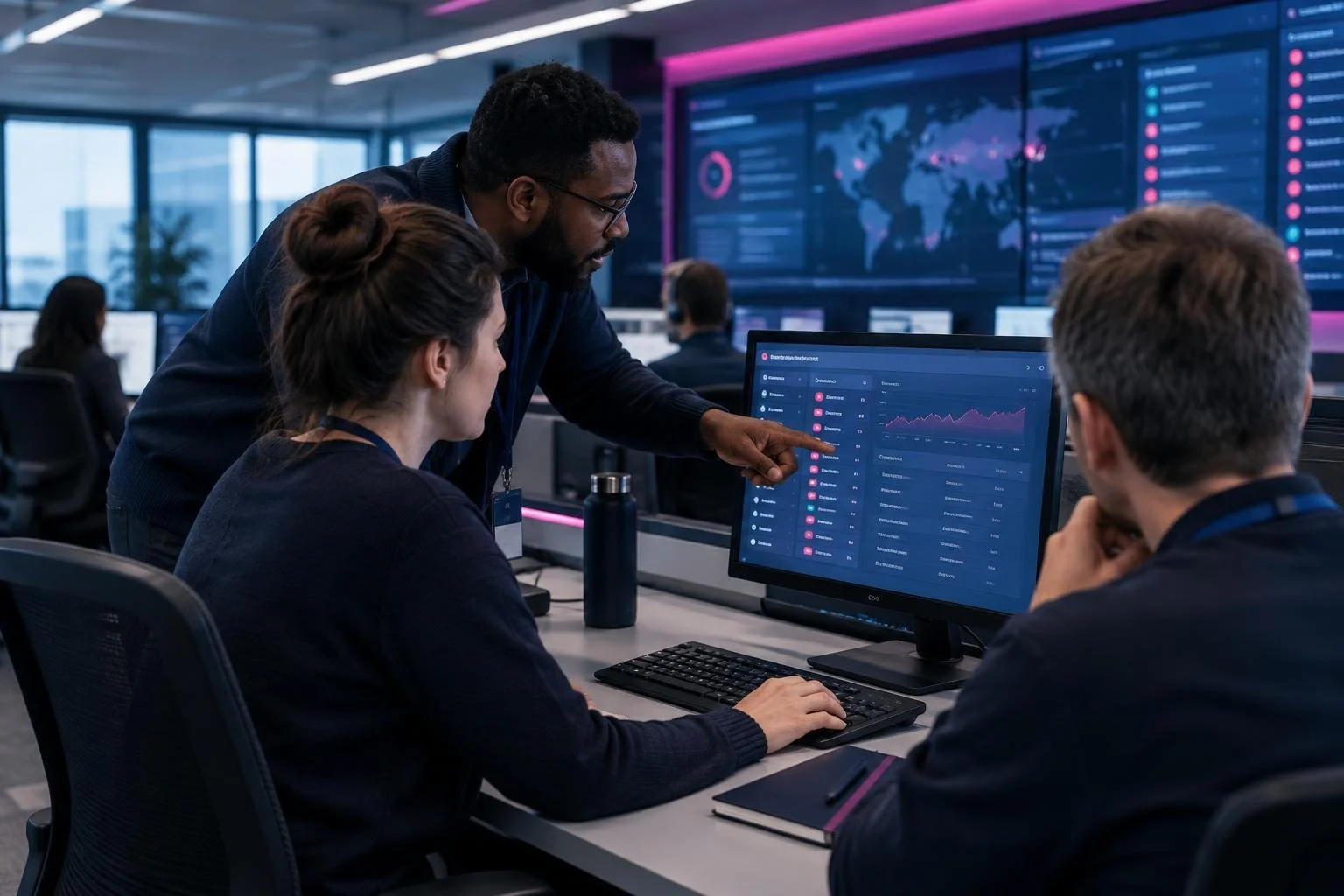
When a security alert arrives, the important question isn't just what it says. It's who will investigate it, who will act on it and how you'll know what's happening. That matters just as much at two in the morning as it does during the working day.
That's why we've partnered with Huntress as our security monitoring solution of choice, bringing its specialist security capabilities into our standard Manage service. We've also integrated Huntress reporting and workflows into the Slink Platform, which supports how we deliver and manage IT services for our business customers.
The aim is straightforward: connect security monitoring with the team managing your technology, and make incidents, reports and status visible rather than leaving them in a separate system.
What we're including in Manage
Our standard Manage service includes Huntress Identity Threat Detection and Response (ITDR), Endpoint Detection and Response (EDR), and Security Awareness Training (SAT).
These address different parts of the security picture. Endpoint detection and response focuses on threats affecting devices. Identity threat detection and response focuses on threats involving user identities and accounts. Security awareness training helps people recognise risks and make better decisions in their everyday work.
They're complementary, not interchangeable. Protecting a device doesn't remove the need to look after the accounts people use to access business systems. Equally, training people to recognise suspicious activity doesn't replace technical monitoring and investigation. A useful security approach needs to consider technology, access and people together.
We're also including Security Information and Event Management (SIEM) for servers we manage, as well as within our standard Managed Network offering. SIEM brings security event information together to support investigation. That inclusion has a defined scope: it shouldn't be read as a promise that every application or system your business uses is automatically covered.
For business leaders and internal IT teams, understanding that scope matters. Security is easier to manage when everyone knows which environments are included and where separate arrangements may still be needed.
Specialist monitoring, with Slink still your point of contact
Huntress's security operations centre, usually shortened to SOC, provides the 24/7 monitoring. Huntress describes its SOC as providing round-the-clock monitoring, analyst-led threat investigation, incident reporting and guidance on next steps. Its Managed EDR service combines endpoint technology with detection and response backed by that specialist team.
Slink remains your point of contact. Our team is also available 24/7 to deal with escalations, connecting those security findings with the management of your wider IT environment.
That distinction is important. Having someone watching for threats is valuable, but monitoring and operational follow-through are different responsibilities. A finding may need technical action, a business decision or coordination with your internal team. The people handling it need to understand the environment as well as the alert.
Our role is to bring those responsibilities together within your managed service. You don't need to work out which supplier to contact before speaking to us about an incident.
Round-the-clock escalation availability isn't a claim that every issue can be resolved immediately, or that disruption can never happen. It means security escalations aren't restricted to office hours.
Visibility that belongs with the work
We've integrated Huntress reporting and workflows into the Slink Platform. All incidents, reports and status are visible there in real time, giving you a shared place to understand what's happening within the service.
The platform isn't a separate security product we're asking you to manage. It supports Slink's delivery of your managed IT service, bringing security information into the same operating picture as the work we're responsible for.
That matters because an alert alone rarely answers every question a business has. You may need to understand the current status, discuss the effect on staff or establish whether a decision is needed from your side. Shared visibility gives those conversations a clearer starting point.
It also supports useful conversations between Slink, business leaders and internal IT teams. Rather than relying solely on a retrospective report, you can see the current picture and discuss it with the team responsible for your service. Real-time visibility doesn't mean every investigation has an immediate answer, but it makes the status of that work easier to see.
What this means for current clients
For our Manage clients, ITDR, EDR and SAT are part of the standard service, rather than being presented as three disconnected purchases. SIEM is included for the managed server and Managed Network scope described above.
The value is in how these elements fit together: specialist monitoring, Slink handling escalations, and reporting connected to our service delivery.
There are still shared responsibilities. Security training needs participation. Changes to accounts, devices and business systems need to be communicated. Decisions that could affect business operations may need input from the right person in your organisation. Bringing security into Manage doesn't remove that collaboration. It gives it a clearer home.
What to look for when choosing a managed IT provider
If you're considering Slink, this partnership is part of how we run and protect your technology, not simply a vendor badge.
A useful way to assess any managed service is to look beyond the list of security tools. Ask what is included, who investigates findings, who handles escalations outside working hours and what you can see while an incident is being managed. Those answers tell you more about the service than a product name alone.
Our approach combines Huntress's specialist security monitoring with Slink's ownership of the managed IT relationship. It can also sit alongside an internal IT team, giving them specialist support and shared visibility without assuming they need to be replaced.
What's next
We plan to add ISPM and ESPM in 2027. These are planned additions, not capabilities we're presenting as included today. We'll explain their scope and practical benefits as those plans are confirmed.
For now, the focus is on making the current service work as a connected whole. Security needs monitoring, but it also needs people available to act, clear responsibilities and visibility for the business relying on it. That's the reason for this partnership.